
Pewter Metal - Everything You Need to Know
Pewter is a metal that has been used for centuries by everyone from master craftsmen to hobbyists. One of the beautiful things about pewter is that it’s easy to start working with, and once you do, the sky’s the limit.
Pewter working is an all-inclusive art that appeals to hobbyists and master craftsmen alike. For that reason, pewter can be found everywhere from hobby shops to well-known luxury goods brands.
In this article, we’ll go over a summary of all the ways that pewter can be used, and we’ll link to other articles with details on how to work with pewter, where to buy supplies and tools, an overview of famous craftsmen, and all the different uses where lead-free pewter metal ends up.
Composition of Lead-Free Pewter
Pewter metal is an alloy made mostly of tin, antimony, and copper, although it can also contain bismuth and silver as well. In the past, it also often included lead, but due to lead’s toxicity, lead has been phased out of many pewter applications. In this article we will only be discussing lead-free pewter.
Over the ages people have referred to pewter using different names. One of the common ones is Britannia Pewter which usually refers to lead-free pewter. It’s important to note that this name isn’t regulated and doesn’t necessarily refer to a specific alloy like sterling silver (92.5% silver) or 18k gold (75% gold).
Pewter Alloy Components
- Tin makes up the majority of pewter which is why pewter is considered a tin-based alloy. In most lead-free alloys pewter is made of between 92 - 98% tin. Higher concentrations of tin make a softer metal.
- Antimony is usually the second highest concentration in pewter, although some alloys don’t contain any antimony at all. It adds strength to the tin and increases workability.
- Bismuth is added to help molten metal flow during casting.
- Copper increases strength and hardness.
- Silver in the alloy makes the metal softer, but it gives a cleaner surface finish when casting, especially for larger, heavier pieces.
Uses of Pewter
Pewter is a popular metal with hobbyists and fabricators because it is easy to work with and it looks great both when it’s new and as it ages. As an added bonus it’s 100% recyclable and non-toxic.
It typically starts as either an ingot or a sheet depending on how it will be used. Sheet metal will either be spun or stamped while ingots are melted down to be cast in molds. From there, pewter gets shaped and finished in a variety of different manners, but usually it will become four main types of products.
Trophies
Pewter trophies are in high demand because they look classic and beautiful, feel substantial, and are the right price point for clubs and companies who don’t want to spend thousands on sterling silver. Bright-polished pewter is a sterling look-a-like metal, so it’s indistinguishable to the untrained eye.
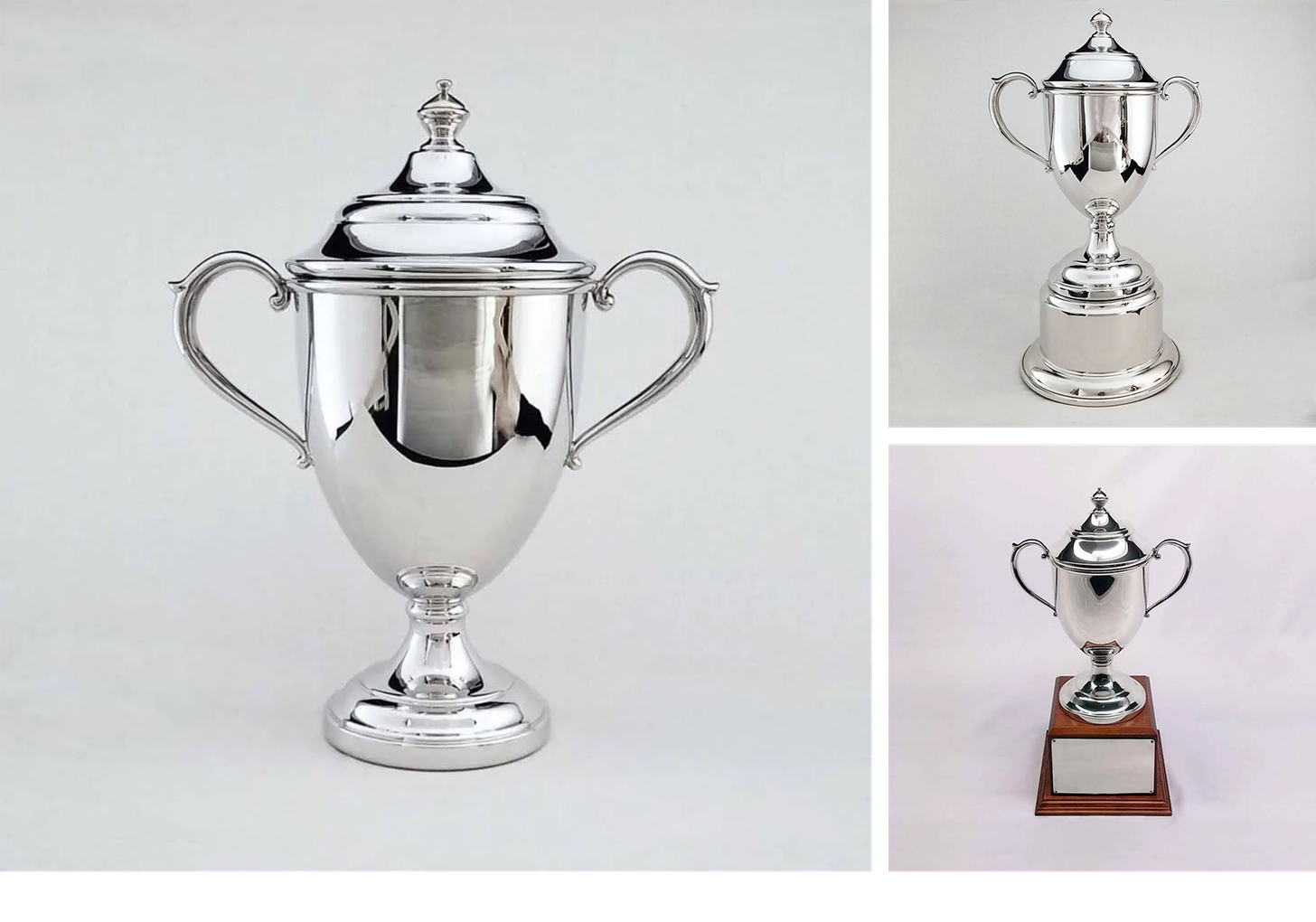
It also doesn’t tarnish, so it’s easier to maintain in the trophy case. Warm water, soap, and a soft cloth is all you need to maintain its shine. DO NOT use silver polish to clean pewter. It will react with the metal and turn it a dark, ugly color.
To read more about how pewter is used in trophies, check out our full trophy article here.
Gifts and Jewelry
Gifts made of pewter take many forms. There are traditional baby cups given to commemorate the birth of a child or grandchild; tankards and picture frames for college graduates; mezuzahs and judaica for religious gifts; souvenirs from our nation’s monuments; and a plethora of Christmas ornaments, statuettes, and handmade jewelry.
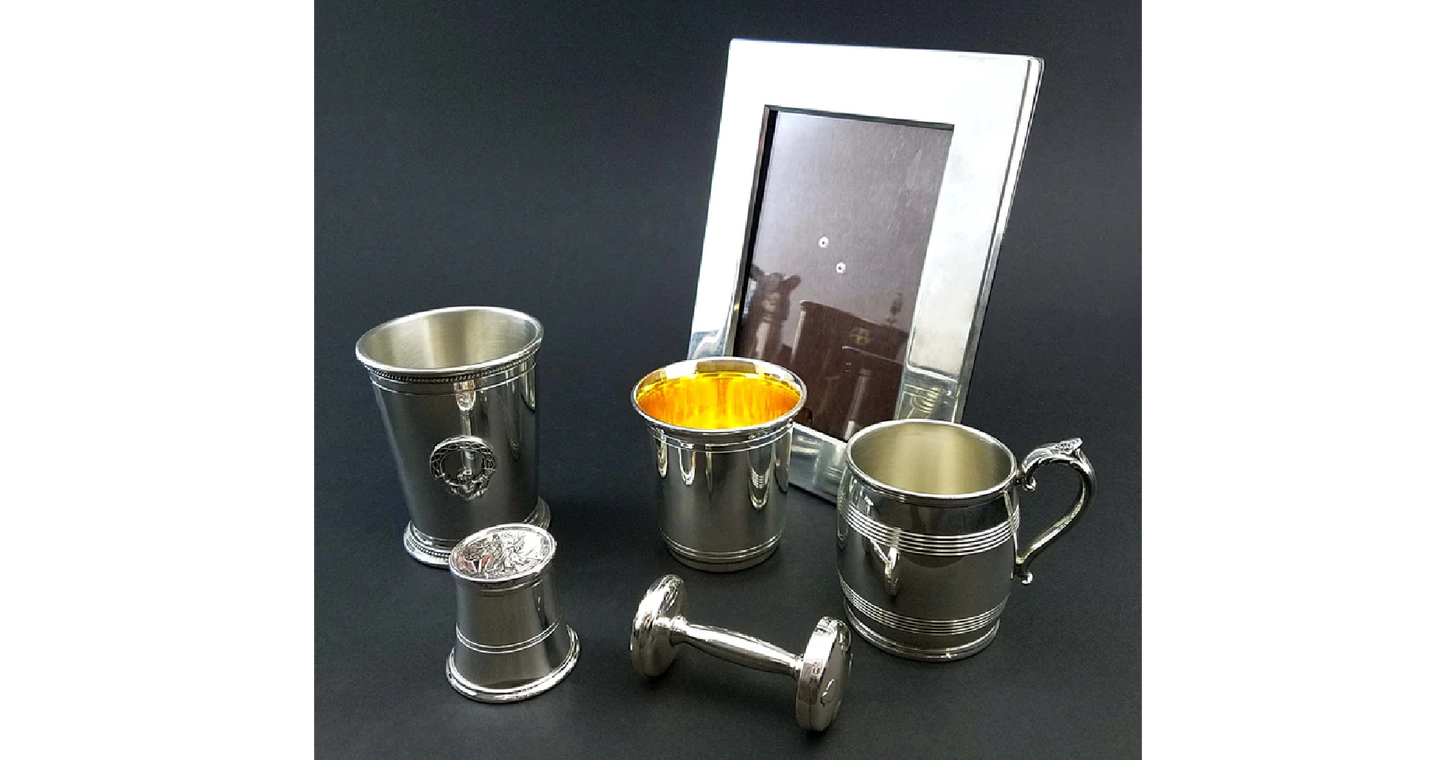
To read more about our pewter gifts, check out the full article.
Countertops and Range Hoods

Pewter countertops are commonplace in high-end restaurants and lavish home bars alike. It’s an ideal choice because pewter countertops wear in with time and use. As it is used and cleaned repeatedly, a patina develops that gives it a well-worn, vintage aesthetic.
Oster Pewter specializes in producing pewter sheet metal in all sizes and shapes. These sheets are then shipped to fabricators who actually produce the countertops to the customer’s specifications. Oster Pewter can provide material quotes for fabricators or direct installers and customers to a number of different fabricators around the country. They are an excellent resource for any information related to pewter countertops and range hoods.
To read more about pewter countertops and see a list of suppliers, check out https://osterpewter.com/countertops.
Lead-Free Radiation Shielding
Not all of pewter’s uses are aesthetic. Pewter is made of Tin, Antimony, and Bismuth which are large, heavy elements that absorb radiation and increase the amount of time that workers can handle radioactive substances without exceeding their daily maximum exposure. Lead is typically the material of choice, but environmental and toxicity concerns have pushed companies to offer lead-free alternatives.
Pewter metal is also used to make radiation shielding for medical devices and for shipping radioactive isotopes. Sheet metal is used as a lining in imaging devices that use a radioactive emitter like x-ray machines.
Also, in surgical procedures like brachytherapy where implanted radioactive isotopes are used to destroy cancer cells, pewter shipping containers are used to transport isotopes through the mail. In all of these scenarios, lead is unusable due to the paperwork, toxicity, and expense of disposal.
Find out more about pewter-use in lead-free radiation shielding applications.
How to Work with Pewter
Since its development, pewter has become a favorite metal for hobbyists and professionals alike due to its easy workability and beautiful finish. It can be finished in a number of different ways to create a look and feel that ranges from pristine to comfortable. Below are several of the main techniques that craftsmen use to work pewter into their unique designs. Click through the links to more in-depth articles to learn how to get started learning these techniques for yourself.
Metal Spinning
Metal spinning is a time-honored tradition that has been around for thousands of years. It’s a lot like making pottery on a pottery wheel, except turned sideways at up to 2,000 rpms. During the process, you start with a circular pewter blank that can have a varying thickness and diameter depending on the job. These blanks are shaped using a forming bar over a tool called a chuck that is typically a solid piece of metal or wood pre-made to the desired shape.
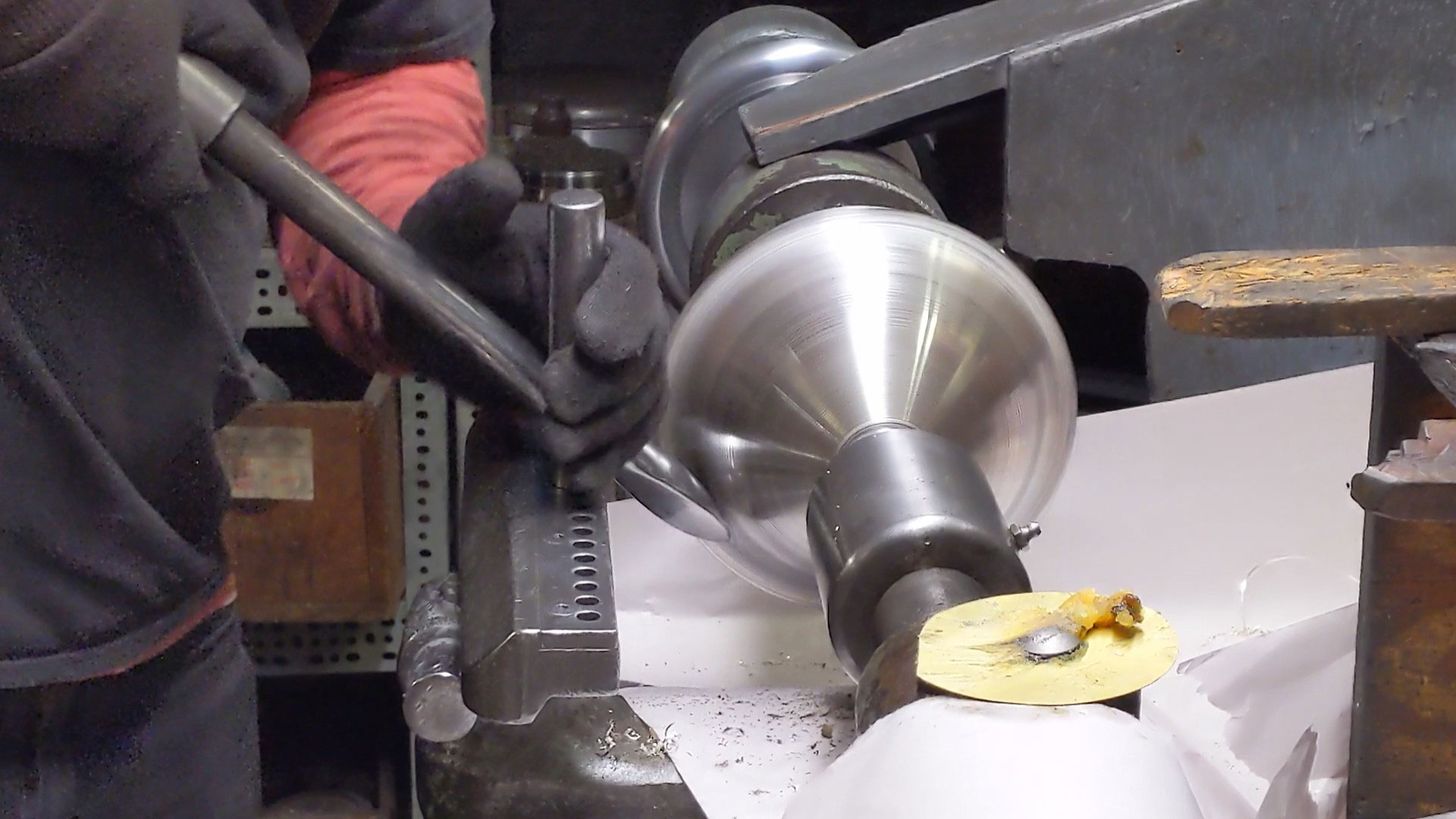
Spinning is the most difficult technique to learn when working with pewter, but it is the way that most bowls, trays, cups, trophies, and holloware are created.
Check out this article on the basics of metal spinning
Pewter Casting

The next method of working with pewter is casting, specifically spin casting. In this method, raw rubber is heated up until it vulcanizes and conforms to the exact shape of a model that is placed inside of it. This creates a cavity within the rubber that molten metal will flow into. The cavity is then vented to allow metal in one side and escaping air out the other.
In order to get metal to enter the cavity and push all the air out without leaving any bubbles or pockets, pressure is applied by spinning the the circular mold. The metal is poured in through the center and rushes into the mold pockets around the outside. In this way sculpted designs are able to be mass produced.
Learn more about pewter casting
Soldering
Whether pewter is spun, cast, or rolled, it’s often that pieces need to be joined together. Typically this is done by torch soldering using low-melt solder, although pewter can also be joined in a method similar to TIG welding where pewter is melted along a seam to join pieces together. Typically when soldering spun pieces together, a pottery turntable or banding wheel is used. This allows the solderer to melt an even bead around the entire circumference of cylindrical pieces. A variety of jigs and holders can be used to hold pieces in place when soldering castings or sheets.
Polishing and Finishing
Pewter is commonly polished in two different styles, bright and satin, although there are other finishes, especially for jewelry and figurines. A bright finish, also referred to as a mirror finish, means that the metal is reflective. Pewter with a bright finish closely resembles sterling silver and is often used as a more affordable option than sterling. Typically trophies and presentation pieces will be done in a bright finish.
A satin finish, also called matte or grey, is more of a traditional pewter look. It is commonly used for pewter that is used regularly like tableware because it doesn’t show scratches or fingerprints as easily. Satin is also very common for figurines and jewelry although it is typically combined with a technique called antiquing or oxidizing that increases contrast and highlights the details in the final piece.
Learn more about polishing & finishing
Stamping
Typically stamping is only used for high-volume production because the cost to make the tooling for stamping out a piece is quite high. Once the tools are made, it is the most cost effective way to form pewter. For holloware or flatware, stamping is sometimes used to create a shell, or partially formed piece, that is then finished via spinning. This is not always the case, especially when stamping out rectangular, oval, or embellished designs that cannot be done via spinning. If you have your own stamp, there are a number of stamping companies that will stamp out your design.
Notable Pewter Companies
Through the height of pewter’s popularity, many master craftsmen emerged who brought new designs and ideas to the market. Each one has a unique story, and added their own mark on the history and development of pewtersmithing.
Preisner Pewter

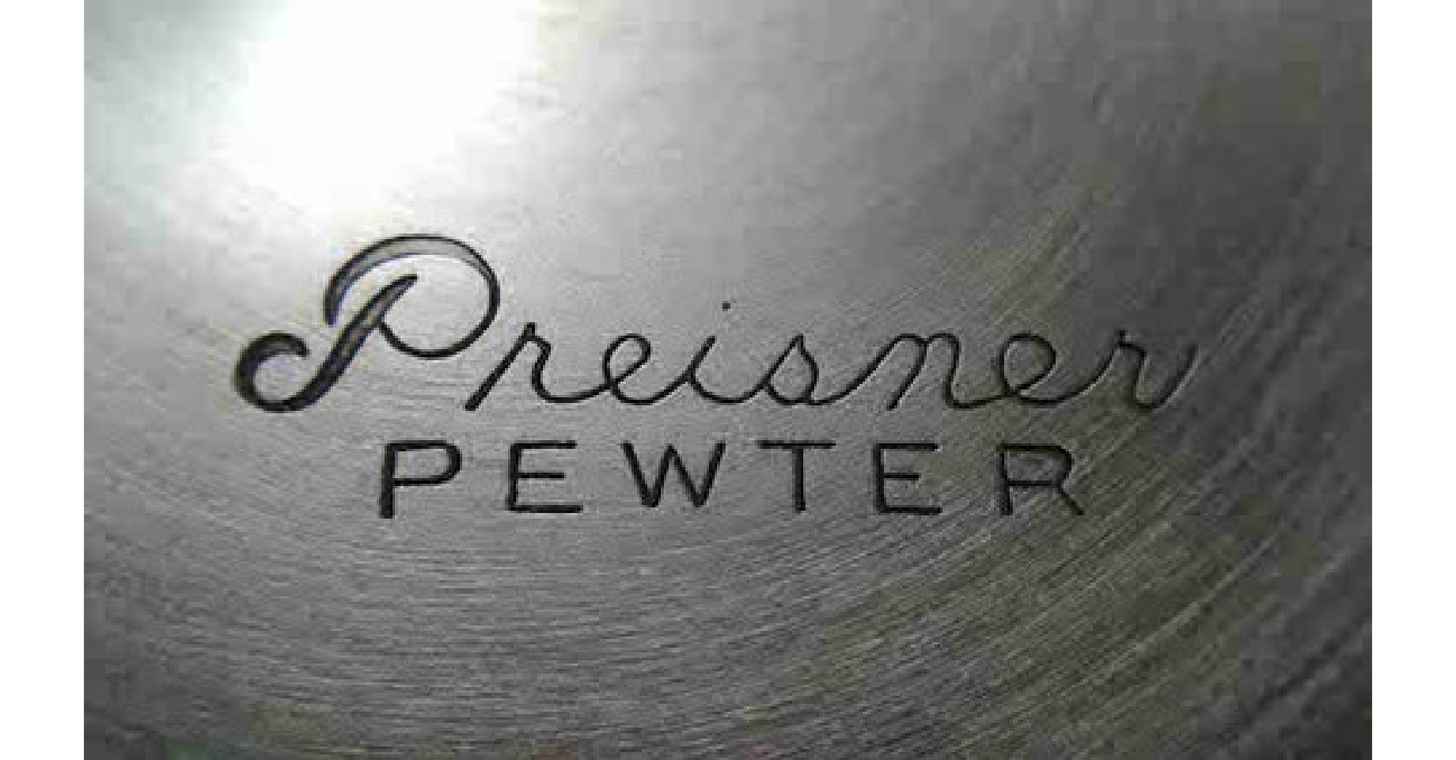
For almost a century, the Preisner Pewter Company has been synonymous with quality pewter and sterling silver trophies, giftware, and luxury goods.
Over the years, Preisner workmanship has been requested by companies famous for their quality such as Tiffany’s, Ralph Lauren, and Cartier.
History
The early days of Preisner Pewter Company were much more difficult than the illustrious time at its peak. Three brothers, Ben, John, and Frank Preisner, founded the company in 1935, before World War II.
When they were just children, they came up from Louisiana with just the clothes on their back. They arrived in Wallingford CT in 1915, and all three became apprentices at Wallace Silver. After working there for years they decided to go into business for themselves.
At first, the Preisner Pewter Company was a huge success and business was booming, but in 1941 the U.S.A. entered World War II.
Pewter and Silver Shortages in WWII
Silver is an incredibly useful and versatile metal, and in the days of WWII metal was in short supply. During the war, silver helped cover country-wide shortages in tin, the main ingredient in pewter, along with nickel, aluminum, and copper.
Today it seems strange that an expensive precious metal like silver substituted for copper, but silver, like copper, is an incredibly good electrical conductor. Besides that it has other properties that allow it to fill all sorts of roles. It was used in everything from electric motors to aircraft ball bearings.
To make things harder, the U.S. military drafted most of their employees. In those days they sold silver and pewter when they could. When they could not, they raised chickens in the company yard for the war effort.
After World War II ended in 1945, their employees came back from fighting overseas. Finally, the Preisner Pewter Company could stop raising chickens and return to pewter and silver production.
The Preisner Pewter Company Today

In the early 2000’s, the Preisner brothers retired from the silver business, and sold the Preisner Pewter Company to the Oldani Family. The apprentices that they taught, now masters, remain with the company and continue to produce the Preisners’ famous line of pewter and sterling silver.
Today, the Preisner Pewter Company continues to manufacture pewter and sterling silver at its location in Meriden, CT under the name and management of Peter and Steven Oldani.
Connecticut House Pewter
Oldani Brothers is the exclusive producer of Preisner Pewter goods alongside lines from both Connecticut House Pewter and Valerio Albarello.
Oster Pewter

Oster Pewter began as a subsidiary of A.J. Oster, an American manufacturing powerhouse that has existed for almost 100 years. At the end of the 20th century, pewter was in a downturn, and A.J. Oster was looking to divest and focus on other areas of the metals industry. At that point John Baldwin stepped up and purchased the division, bringing it under the roof of his company, Callico Metals.
From the year 2000 to 2021, John Baldwin perfected the process of making high quality pewter sheet metal with alloys and a grain structure that were especially suited for the pewter spinning industry. He also expanded Oster Pewter’s capability to accommodate the large sheet sizes needed for pewter countertops.
In 2021, Oldani Brothers, a long-time customer, acquired Oster Pewter in the hopes of preserving the pewter industry within the United States and expanding it to fill new niches in other areas.
Today, Oster Pewter continues to produce custom-cut pewter sheet metal and a variety of lead-free pewter alloys. For more information, visit the Oster Pewter website.
This post was written by Peter Oldani. Find out more about the author.
Related posts

Pewter Casting
Due to its low melting point, pewter is an easy metal to cast. Pewter casting is a way to take a sculpted model or figurine and reproduce it using rubber molds and a spin casting machine.

The Principles of Spinning Pewter Sheet Metal: Chapter 1
An introduction to the art of metal spinning, this book from the early 1900s is an excellent resource to start into spinning pewter and sterling silver. Spinning pewter sheet metal is a very traditional technique, and despite the age of the book, the same methods still apply today.

Pewter Polishing & Finishing
Pewter metal is highly valued for its finish. Depending on preference, it can have a bright, mirror finish that looks like sterling silver but doesn't tarnish, or it can have a satin finish that develops a patina over time.
