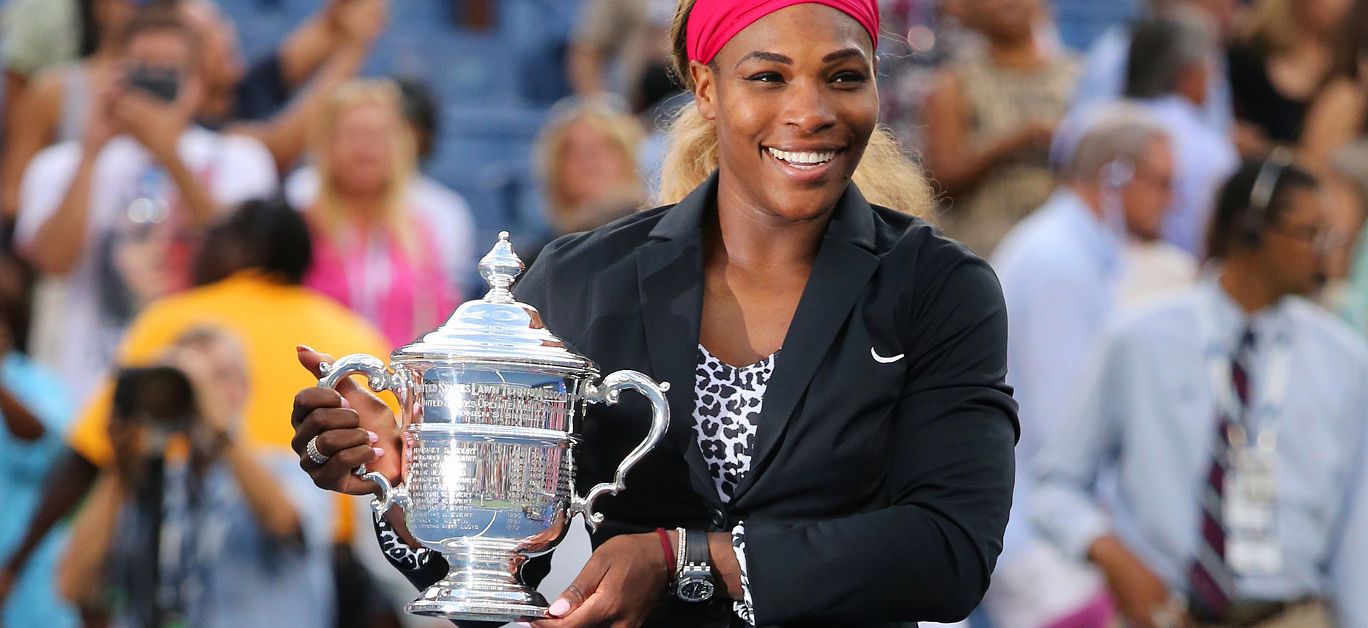
The Grand Slam Tennis Trophies
The adoring fans, the monetary prize, and the fame are not the only things that motivate tennis players to win a Grand Slam. Indeed, it is the thrill of raising the trophy above their heads in front of the roaring crowd that fuels the players. The origin of the term ‘Grand Slam’ comes from the card game contract bridge, or simply bridge, a trick-taking game where it is used to describe taking all possible tricks.
It entered the sports world via golf, where it was used for the first time in 1930 to specifically describe Bobby Jones’ feat of winning the four major golf tournaments. In tennis, the term Grand Slam refers to the achievement of winning all four major championships - in chronological order the championships of Australia, France, Britain, and the United States - in a calendar year.
The feat has been achieved only six times by five different players that won all four trophies in the same calendar season. In this article we delve into the history of each of the four major tennis championships, commonly referred to as Grand Slam tournaments nowadays - the Australian Open, in January, the French Open in late May and early June, (British) Wimbledon from late June to early July, and the US Open from late August to early September - and their much sought-after tennis trophies.
The Australian Open, The Norman Brookes Challenge Cup, and The Daphne Akhurst Memorial Cup
The Australian Open marks the start of the Grand Slam season of the year, played for two weeks from late January to early February each year. The first edition took place in 1905 on grass courts under the name Australasian Championships.
Since 1988, it has been played on hard courts. Nicknamed “the happy slam” the Australian Open is the highest-attended Grand Slam tournament, with over 900,000 people attending the event in 2023, and distinguishes itself through its modernity and innovation. For instance, it has been the first Grand Slam event to feature indoor play during wet or extreme weather, first to install retractable roofs on its main courts, and first to schedule night-time finals.
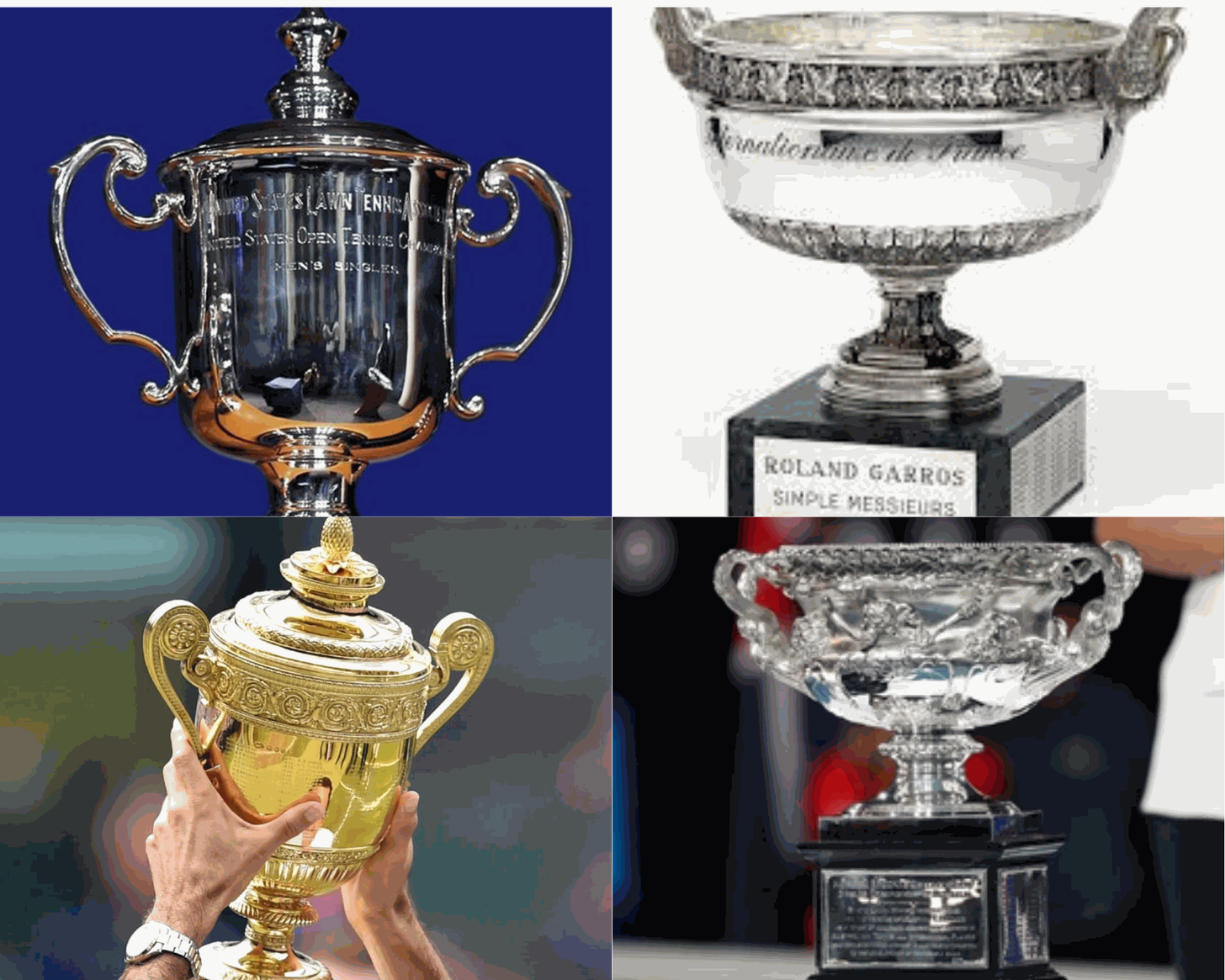
Two iconic trophies are presented each year to the men’s and women’s singles winners of the Australian Open. The Norman Brookes Challenge Cup is awarded to the men’s singles champion. It is named in honor of Sir Norman Brookes, a former Australian tennis champion who won three Grand Slam singles titles during his career and five Davis Cup titles. The silver-gilt trophy was modeled by an English silversmith in 1906 after the Warwick Vase - an ancient Roman marble vase, discovered at the ruins of Roman Emperor Hadrian’s Villa outside Rome, and named after the Warwick Castle where it is now displayed.
The Daphne Akhurst Memorial Cup, also known as the ‘Daphne’, is the sterling silver trophy presented to women’s singles champions, named after Daphne Akhurst , a five times singles champion. Both the men’s and women’s singles winners take home smaller-scale replicas of the trophies.
The French Open, the Musketeers’ Cup, and the Suzanne-Lenglen Cup
Officially named in French les Internationaux de France de Tennis (English: the “French Internationals of Tennis”), the French Open, also known as Roland-Garros, is the second Grand Slam tournament of the year, held from late May to early June each year, and is generally considered the most emblematic clay-court tournament.
It was first held in 1891, in Puteaux, Île-de-France, and since then changed venues several times, until 1928 when it settled at Roland-Garros in Paris, France. Interestingly, both the venue and the tournament itself are called Roland-Garros, after the French aviation pioneer.
Until 1975, the French Open was the only Grand Slam tournament not played on grass. From 1975 to 1977, the US open used clay courts as well, but since the US Open changed to hard courts in 1978, the French Open has been the only Grand Slam tournament played on a red clay surface. Given the clay surface characteristics, such as slowing down the ball and producing a higher bounce, the French Open is generally regarded as the most physically demanding tennis championship in the world.
This, in turn, makes the Roland-Garros trophies some of the most coveted awards in sport since the process of winning them is so demanding. The trophies have been awarded to the French Open winners since 1953, and are manufactured by La Maison Mellerio, a famous Parisian jewelry house dating back to the 17th century. The men’s singles champion has been awarded La Coupe des Mousquetaires (English: The Musketeers’ Cup) since 1981.
The trophy is named in honor of the four Musketeers of French tennis: Jean Borotra, Jacques Brugnon, Henri Cochet and René Lacoste. The trophy is a silver bowl bordered with vine leaves, and decorated with handles shaped like swans. It is mounted on a marble base engraved with the names of the winners.
The winner of the women’s singles competition has been awarded the Suzanne-Lenglen cup since 1979, named after the emblematic French tennis player who won Roland-Garros six times. The design of the trophy is almost identical, except for a few details, to the trophy awarded by the city of Nice to Suzanne Lenglen. In both cases, the champion takes home a smaller-size replica of the trophy.
Wimbledon, The Gentlemen’s Singles Trophy, and the Venus Rosewater Dish
The Wimbledon Championship, commonly referred to as just the Wimbledon, is the oldest tennis tournament in the world and is widely regarded as the premier tennis tournament in the world. The tournament takes place over two weeks from the last Monday in June until early July.
It had been held at the All England Lawn Tennis and Croquet Club since 1877, and is the only Grand Slam tournament that is still played on grass courts, which had originally been the tennis playing surface. Wimbledon still holds many traditions besides the playing surface, having been described as having a “David Niven-ish propriety” by social commentator Ellis Cashmore, as it is still trying to conform with social standards evoking the 1950s.
Wimbledon traditions include royal patronage, minimal and low key sponsorship, notably from Rolex and Slazenger who have supplied all tennis balls for the championship since 1902, and mandating competitors to wear all-white or at least almost entirely white tennis attire, off white or cream not being regarded as white.
Another tradition is that the “Men’s” and “Women’s” competitions are referred to as “Gentlemen’s” and “Ladies” competitions. It is also the only major that retains a night-time curfew, though tennis matches are now allowed to continue until 11pm. Finally, “Strawberries and cream” are traditionally consumed by the spectators, a tradition dating back to King Henry VIII, which has become a cultural symbol of the tournament. Five main events are held each year, including Gentlemen’s Singles, Ladies’ Singles, Gentlemen’s Doubles, Ladies’ Doubles, and Mixed Doubles.
The Gentlemen’s Singles Trophy was first presented in 1887, replacing the Field Cup ((1877-1883) and the Challenge Cup (1884-1886) after they had both been won by William Renshaw, winner of the Gentlemen’s Single three years in a row. After this incident, to mitigate the risk of losing a third Cup, the All England Lawn Tennis Club (Championships) Limited, or the AELTC decided the new trophy would not become the property of the winner. The 100 guineas trophy is a silver gilt cup with a lid, and stands 18 inches tall with a diameter of 7.5 inches.
It bears the inscription The inscription on the Cup reads: “The All England Lawn Tennis Club Single Handed Championship of the World”. The dates and names of every champion are engraved around the bowl. In 2009, since there was no space left to engrave the names of the champion, a black plinth with an ornamented silver band was added. Rafael Nadal was the last tennis player whose name was engraved on the trophy itself before this change.
The Cup is decorated with a variety of symbols, of which the most notable one is a miniature gold pineapple that crowns the trophy. The symbol fascinates fans all over the world. While there is no definitive answer as to why the trophy features the pineapple in the first place, according to a spokesperson from the Wimbledon Museum, it could be that in the 17th century pineapples were an exotic and rare fruit that could not grow in the UK and therefore had to be imported, thus indicating that being presented with one could represent a great compliment.
Other theories refer to the symbolism of the pineapple as a sign of hospitality and recognition, British sailors being said to have adorned their house entrances with a pineapple in sign of hospitality. Since the trophy no longer becomes the property of the champion, winners now receive a three-quarter size replica of the Cup. The Ladies’ Singles champion is presented with a silver salver commonly referred to as the Rosewater Dish or Venus Rosewater Dish.
A Rosewater dish is a platter used to wash hands with rosewater after eating, which used to be a daily ceremony in England. These dishes were traditionally made of pewter, sterling silver, or gold. The 50 guineas trophy is made of sterling silver, partly gilded, measuring 18.75 inches in diameter. It was first presented to the champion in 1886, when the challenge round was introduced.
It is decorated with mythological symbols, including the figure of Sophrosyne (not Venus) at the center, who was the personification of temperance, and Minerva on the rim. Similarly to the Gentlemen’s Singles Trophy, the champion of the Ladies’ Single receives a three-quarter size replica of the Cup.
The US Open
The US Open Tennis Championships, commonly called simply the US Open, has been the fourth and final Grand Slam tournament of the year since 1987, played annually for two weeks from the last Monday of August until early September, with the middle weekend overlapping with the US Labor Day bank holiday.
The championship is one of the oldest tennis tournaments in the world, first held in August 1881 in Newport, Rhode Island, United States. Back then it consisted of men’s singles and men’s doubles only. Since then, the tournament changed venues several times, and since 1978 it has been held at the USTA Billie Jean King National Tennis Center in Queens, New York City.
Today it consists of five main championships, men’s singles, women’s singles, men’s doubles, women’s doubles, and mixed doubles. Since 1978, it has been played on outdoor hard courts. The winners of the US Open Singles and Doubles Championship are presented sterling silver trophies which have been designed and made by the jewelry brand Tiffany and Co.’s silversmiths in their Rhode Island workshop since 1987.
The trophies stand approximately 18 inches tall, and 6 inches wide, and weigh about 10 pounds. They feature two adorned handles on either side and a lid. The trophies are hand engraved with the names ‘The United States Lawn Tennis Association’ in capital letters and the US Open’s earlier name, ‘The United States Open Tennis Championships’.
Similarly to all other Grand Slam events, the champions of the US Open do not take the original trophy home. However, unlike the other three major tennis events, where the champions get a scaled down replica, the US Open’s champions receive 1:1 replicas of the original trophy.
The Grand Slam Winners
The first tennis player to win all four major tournaments in one year and thus capture the Grand Slam was Don Budge (United States) in 1938. Since Budge, four other singles players have completed the Grand Slam. Maureen Connolly (United States) became the second-ever- and first woman to accomplish the Grand Slam in 1953, followed by Rod Laver (Australia) in 1962 and again in 1969. Margaret Smith Court (Australia) became the fourth and Steffi Graf (Germany) became the fifth player to claim a Grand Slam in 1970 and 1988, respectively. To date, nine double players, one junior, and in wheelchair disciplines, two singles and twelve doubles players have completed the Grand Slam.
Custom trophies and private commissions for your tennis championship
There’s no denying that lifting a Grand Slam trophy after winning the French Open, the US Open, Wimbledon, or the Australian Open, must be exhilarating. Taking all four of them home must be out of this world. Nevertheless, one doesn’t have to be a Grand Slam champion to deserve a trophy after a hard-earned tennis win.
Besides, they say that even when they are young, many tennis players design their own trophies since their sight on their shelf gives them the motivation to work hard and win a Grand Slam trophy one day. Victories big and small deserve to be celebrated, and here at Oldani Brothers we offer bespoke trophy-making services that help you capture the spirit of victory for your tennis club’s championships and tournaments.
Oldani Brothers is a family owned silver and pewtersmith that prides itself with timeless pieces and modern heirlooms. Learn more about our trophies and custom options.
Or contact us at:
(203) 630-6565 sales@oldanibrothers.com
This post was written by Peter Oldani. Find out more about the author.
Related posts
The Greatest Sports Trophies of All Time
The history of trophies dates back thousands of years, and trophies have become a symbol of victory, presented to this day to sports teams and individuals to recognize their achievements across sports competitions and tournaments.

Excellence in Golf: Trophies to Remember

The Kentucky Derby - Southern History and Tradition
With a history spanning nearly a century and a half, a world-famous 14-karat gold trophy topped by an 18-karat gold horse and jockey, tens of thousands of visitors traveling to Kentucky every year to take part in the events associated with the derby, and long-standing traditions such as...
